I’m not at Superbooth, but one of our OSCars is. There have been a few sleepless nights to get it over the line. Paul Whittington’s more camera-ready than I am. Here he is, surrounded by synths I’ve had a hand in designing.
(Three models is just enough to use the verb ‘surrounded’, I think. Really, they’re all co-production credits. I’ve laid out a lot of boards, written a lot of firmware, and dealt with a lot of manufacturing stuff. But I don’t know how one crosses the floor in this industry from craftsman to auteur.)
In the smoke-and-mirrors department, there’s still a lot OSCar doesn’t do. The list begins with saving patches, arpeggiating, sequencing, syncing, and the PWM and waveform-designing features, all of which are going to benefit from some user interface reappraisal.
I also need an antialiasing day to prove to myself that I have determined the source of it all, and that I can fix it. In theory, OSCar will never alias: as covered in previous posts and talks ad nauseam, its sample rate is locked to the note frequency, so aliases become harmonics.
Most of what you hear on that video, especially obvious on the Init Patch (nowhere to hide with a full-range sawtooth), is aliasing from a different source. The Superbooth unit has an uncorrected design fault on the CV filters, which I didn’t spot in time. The voltage references to the DAC therefore have a lot of the 35kHz CV carrier frequency on them, so the DAC dutifully turns into an amplitude modulator, makes a bunch of arbitrary sidebands, and then sample-and-holds the result. That’s what you’re hearing. When the filters work as intended, those sidebands will be more than 90dB down. I live in dread of finding out that the filters can still pick them out.
I think I might also have a problem with the two oscillators interacting, but that’s just a hunch: if it’s happening it’ll be caused by the accurately clocked sample-and-hold at the end of the audio chain, that’s copied from OSCar, being driven by the wrong duty cycle or having the wrong capacitance. This is why I need a day just to make sure I’ve tackled all the fidelity issues before knocking out another PCB.
Sound-wise, the other known problem to resolve is treating the PLLs that multiply up the clock. My design needs to restrict the multiplied-up clock range, which drives the sample rate, to a little over an octave, and fold over at that limit. PLLs don’t, of course, handle the step change too elegantly and you get a few clicks of complaint when that happens.
OSCar didn’t have to fold over as much. First, because it was confined to a five-octave range that a VCO can easily manage. I don’t know if customers would be happy with that now: I wouldn’t. Second, because a lot of the clock folding was done by external counters, which can change rate instantly. Chris was therefore able to run his VCOs at more than 500kHz; mine trigger an interrupt each time so I can’t go quite that quickly. All of which leaves me a little exposed. Still, nothing that a bit of solder and a lot of thought can’t fix.
The work is paying off because, apart from those flaws, it sounds pretty good (judge for yourself: playing starts at 4:20). This is pretty much the most success I’ve had from any design’s version-one hardware, although it’s kind of version two because I built that Z80 clone and learned from my mistakes.
The downside of presenting a first-issue board is that it’s actually a sign that the second issue is overdue. The one at Superbooth is about four iterations deep of learn-something-fix-something. At some point you need to clean the slate, but I want to run a couple more tests first.
Everyone’s a critic
We’re long past the stage where it’s too early to solicit criticism. There’s always the risk of misaligned expectations, though. One of the certainties of a creative profession is that the first tentative outing will be judged by the same standards as a final product. One needs to learn to accommodate this kind of thing:
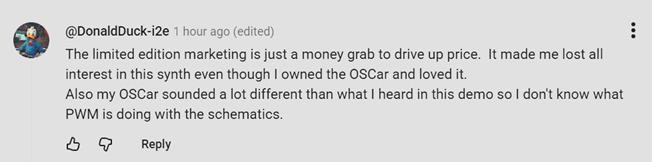
It’s peculiarly gratifying to be reminded about why I’m already anxious. But, first, luxury product: price reflects performance, effort, and the fact that exclusivity is expensive. One selfish reason for keeping this blog is that the act of writing helps to clarify and focus the mind. But another is to signify the amount of thought, care, and skill involved in completing a synth, even — or especially — if the template is a product that already exists.
Lest we forget, even if you scraped the new-old-stock parts together, got the PCBs faithfully copied, and tooled up to reproduce a design to Anthony Harrison-Griffin’s original spec, you could not legally sell a part-for-part replica of an OSCar today because it wouldn’t pass an EMC test and earn its FCC or CE accreditation. From time to time, of course, individuals do produce a short run of clones after this fashion, but they’re doing it out of love, are too small to go after, and frankly, you’d have to be a special kind of dickhead to want to spoil their fun.
So first, we need to get to a completely working OSCar with production parts and a compliant design. Which we’ve also been fixing, hardware- and software-wise, in myriad ways, so it’s less fragile and electrically quieter than the original. We then add a load of conveniences: USB bus power, velocity sensitivity, comprehensive MIDI control, a frequency range that takes it down to floor-shaking frequencies, and numerous other features that people either want or expect from a modern instrument. Even if you think minimum wage is ten times too much to pay to watch me having fun doing a thousand hours of unforgiving maths, this is a bargain.
Second, we have Chris’s OSCar #1 so, when we decide to declare it ready, we’ll do so with authority and evidence. Frankly, what matters to me? Not being the person who dares to presume without merit on Chris Huggett’s legacy, and mucks this up.
Third, brand launches have gone a lot worse.
There’s a danger that design work slows down because I waste too much time enjoying my own prototype. Not yet, though: my excuse this week will be that I’ll need to go and think about something else for a while until my eyes uncross again. Perhaps I’ll disassemble the arpeggiator.
Leave a Reply