It’s been months, I know. I’ve been quietly getting on with OSCar, and a few revisions to the Head Tracker, and dealing with the usual stuff of life. So I want to sneak out an update to that effect before publishing the usual ADC transcript.
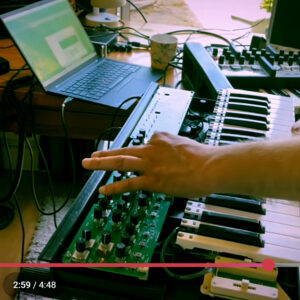
There was a bit of a strange play-fest a few months ago involving Synth Samurai where I played old and new OSCars together at Paul’s place while he filmed me surreptitiously. More work has happened since, of course. The factory presets on the two are now indistinguishable, except that the new OSCar is properly in tune, and electronically quieter.
I’ve come to the conclusion that there’s three reasons for OSCar’s reputation for poor reliability:
- The SRAM backup battery was a NiCad and they always leak. Fortunately the battery was mounted to the control surface so, when the memory fails, it doesn’t take the rest of the synth with it.
- OSCar is held together by exquisitely-tuned timing circuits, set by ceramic capacitors and 74LS-series logic working to delay some rise and fall times with respect to others. Single-digit nanoseconds make all the difference, but capacitances drift as dielectrics age. Tricks like the ‘get eight control voltages and two audio signals out of a single mono DAC’ start to fail. And if anything goes wrong with the ‘read the wavetable data during the Z80 refresh cycle, let it settle in the DAC, and then poke it through the sample-and-hold demultiplexer gate before everything else wakes up again’ hack, going a bit noisy is the best-case scenario.
- The user interface design means that you’re only ever a button press away from losing the unsaved preset you’re working on, or saving over a slot you were using, of which there are only 36. You can’t preview, you can’t undo, and you can’t back things up to MIDI or cassette individually: it’s everything or nothing. I suspect a few OSCars have found their way into the studio car park via a first-floor window.
All the dull stuff, like the bootloader and the proper production memory map, are now in place. Presets load and save, and the MIDI tools we give to sound designers for Mantis are now fully compatible with OSCar too. There’s a lot still left to do, though. I keep thinking of improvements to make to the user interface that fall under what I might loosely call my principles:
- Respect the original restrictions and workflow: they are what makes Chris and OSCar Chris and OSCar.
- If it’s genuinely broken, don’t make excuses but fix it instead.
- Modern conveniences, like undo and working MIDI, are non-negotiable.
- Leave some places to hide easter eggs, and try not to give the game away.
These are almost always mutually incompatible, so it comes down to taste. It’s now a race to work these out because the front panel design freeze deadline is fast approaching.
Leave a Reply